Welcome, Neighbors of
Hudson
AC Repair in Hudson, CO
Hudson is a small plains town where the wind never really stops and the nearest anything is a drive away. That is exactly why, when your cooling quits, you want a company that actually comes out. We do. Family owned, licensed and insured, serving Hudson since 2009.
5-star rated · Local & Family-owned since 2009
Licensed & Insured
Family Owned
NATE Certified
EPA Certified
BBB Accredited
Serving Denver Metro

See your neighbor deals
MoJo Home Services
Out in your neighborhood · Denver Metro
AC Repair in Hudson, Colorado
Hudson sits at exactly 5,000 feet, which makes it the cleanest piece of arithmetic on our service map: a 12.0% gas derate under the NFPA 54 convention of 4% per 1,000 feet above 2,000 feet, and air about 13.8% less dense than at sea level. It is also a Weld County address, which means replacement work routes differently from the Adams County towns a few miles south. We have been running this corridor since MoJo Home Services opened in 2009. Reach us on 720-807-4050 — licensed, insured, EPA-certified, and no part gets named before the readings are taken.
What does exactly 5,000 feet do to an air conditioner in Hudson?
It costs capacity on the air side. Cooling depends on the mass of air moved across the evaporator, not the volume, and at 5,000 feet each cubic foot carries about 13.8% less mass than at sea level. Where a sea-level design sheet says 400 per ton, Hudson wants about 464. The total-heat constant of 4.5 becomes about 3.88, and the sensible-heat constant of 1.08 becomes about 0.93. A three-ton Hudson system measuring a textbook 1,200 CFM is delivering the mass-flow equivalent of closer to 2.6 tons, which is why an apparently correct system still falls behind on a design day.
Why is refrigerant charge the most misread measurement in Hudson?
Because manufacturer superheat and subcooling charts are printed for standard air, and at 5,000 feet the air crossing both coils is not standard. A technician who reads those charts literally in Hudson sees numbers that suggest an undercharge and adds refrigerant to a system that was never short. That raises head pressure, increases compressor discharge temperature, and shortens equipment life while the actual fault — usually airflow well below 464 CFM per ton — goes untouched. The correct sequence is to establish airflow with a static-pressure reading first, then interpret subcooling with that airflow known. Charge is a conclusion, not a starting point.
What fails most often on Hudson air conditioners?
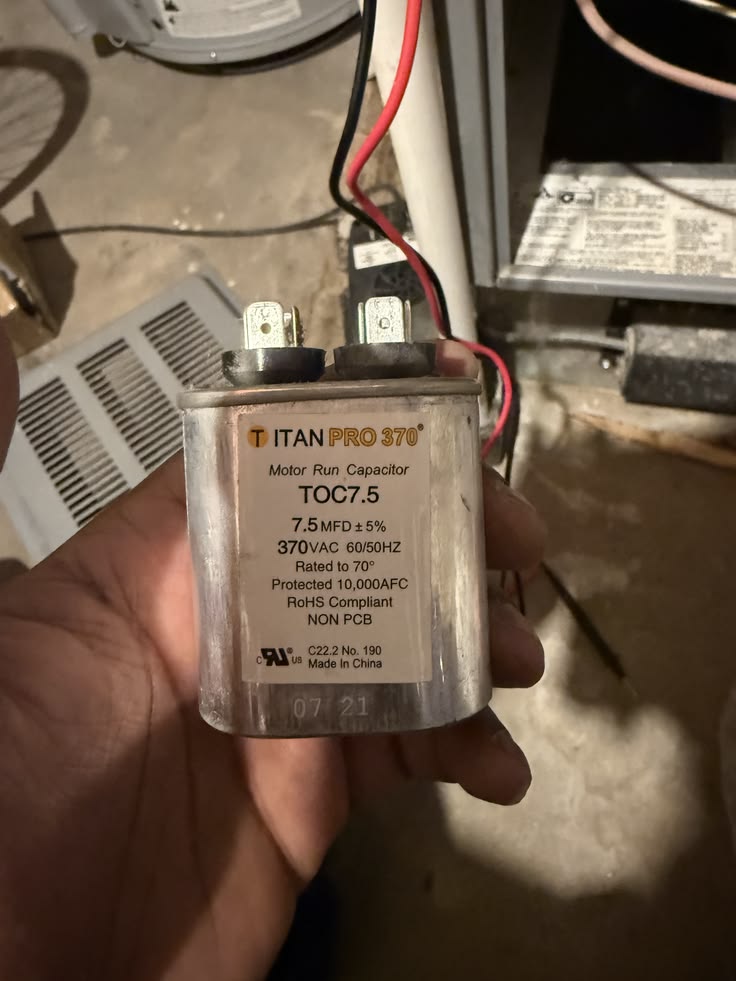
Capacitors that no longer measure what the case says they should, contactors worn by repeated switching, outdoor coils packed with dust and seed off open Weld County ground, drain lines that clog until a float switch cuts the system, and refrigerant creeping out of flare fittings and valve stems a few ounces a season. On systems that have been topped off more than once, the leak is still there and the accumulated overcharge has usually made the symptoms worse. We look for the leak rather than refilling around it.
Which repairs are worth doing on an older Hudson system?
Refrigerant type usually decides it. Anything from before about 2010 will almost certainly be an R-22 machine, and R-22 has not been produced in or imported into this country since 2020 — every pound now comes out of reclaimed stock, spent on a unit already close to the end of its life. Systems charged with R-410A are a different matter; parts and refrigerant are both ordinary. Equipment sold new today ships on R-454B, the result of a phasedown that took effect in 2025. Electrical repairs — capacitors, contactors, fan motors — are almost always worth doing regardless of age. Sealed-system work on R-22 in Hudson rarely is.
Who permits air conditioning replacement in Hudson?
Weld County, not Adams. Hudson is a Weld County town of 1,571, and equipment swaps here follow the county's building department rather than the routing used for Henderson or Commerce City to the south. Replacement documentation should show a load calculation built on 5,000 feet and a 12.0% derate, and the condenser should be paired with an AHRI-matched indoor coil. A mismatched coil undermines both rated capacity and any subsequent charging measurement.
What does Hudson's exposure do to outdoor equipment?
Open ground means wind-carried grit reaching the condenser coil with nothing to slow it, and unshaded units taking full afternoon sun. Both raise condenser approach temperature, and at 5,000 feet the coil is already rejecting heat into air 13.8% thinner than its rating conditions. Annual coil cleaning recovers real capacity here without opening the sealed system, and a level pad with proper clearance around the unit does more for longevity than most add-on accessories.
Weld and Adams County neighbours
Lochbuie sits southwest and straddles the same county boundary question. Fort Lupton is the other Weld County town on this route, and Henderson, 23 feet higher at 5,023 feet, is Adams County. We carry Hudson-specific numbers rather than a single plains-wide assumption.
Same crews, neighbouring towns
The same trucks run AC repair in Lochbuie, AC repair in Fort Lupton, AC repair in Henderson on the same rotation.
Heating and cooling fail for different reasons in the same house — see furnace repair in Hudson.
More: AC repair · everything in Hudson.

Hudson
Home Of The $39 Diagnosis
Book your diagnostic today!
The $39 diagnostic service is a professional troubleshooting visit performed by a certified MoJo technician to identify the root cause of an HVAC issue.
Frequently Asked Questions
Why does a Hudson system need more air than the label suggests?
Because equipment labels are written for sea-level air. At Hudson's 5,000 feet each cubic foot carries about 13.8% less mass, and mass is what removes heat, so the target climbs from 400 per ton to roughly 464 — near 1,390 CFM on a three-ton system. The figure of 4.5 that appears in total-capacity calculations slides to roughly 3.88 for the same reason.
Why does adding refrigerant not fix my Hudson air conditioner?
Because superheat and subcooling charts assume standard air, and at 5,000 feet the air across both coils is 13.8% thinner. Read literally, those charts suggest an undercharge on a system that is actually short of airflow. Adding refrigerant raises head pressure and discharge temperature while the real fault, airflow below 464 CFM per ton, stays untouched entirely.
Is an older Hudson air conditioner worth repairing?
It depends on the refrigerant. A pre-2010 unit is nearly always an R-22 machine, and R-22 has not been made or imported here since 2020, so opening its sealed system means spending reclaimed refrigerant on an old unit. R-410A equipment is worth repairing; new units arrive on R-454B after the 2025 phasedown. Electrical parts justify replacement at almost any age.
Who issues permits for HVAC replacement in Hudson?
Weld County, not Adams County. Hudson is a Weld town of 1,571 residents, so equipment replacement follows Weld's building department rather than the routing that covers Henderson or Commerce City to the south. Documentation should reflect the 5,000-foot elevation and 12.0% derate, with an AHRI-matched condenser and indoor coil.
How often should a Hudson condenser coil be cleaned?
At least once a year. Hudson's open Weld County exposure sends wind-carried dust and seed into the outdoor coil all season, and a loaded coil widens approach temperature and raises compressor amperage. At 5,000 feet the coil is already rejecting heat into air 13.8% thinner than standard, so it has less margin to give away before capacity drops noticeably.
MoJo Home Services
A note for our neighbors
In Hudson the same family name often turns up on more than one house in town, so a single good visit can quietly become a whole family's worth of calls. We are grateful for that, and for every AC repair we get to do because a relative put in a word.

On the job
In
Hudson
Share Your Experience
Thank you for supporting our local family business. If we did right by you, we'd love to hear about it on any site you use.
- Write a Google reviewQuick & easy
- Find us on YelpRead what neighbors said
- Review us on FacebookShare with friends
- Recommend us on NextdoorTell your neighbors


Your referrals and reviews not only mean so much to us, they also help the community know who to trust to Get their Home's MoJo Back!
Honest feedback is what we're after, good or bad. If something fell short, call us at the office first and we'll make it right.