Welcome, Neighbors of
Dakota Ridge
Furnace Repair in Dakota Ridge, CO
Dakota Ridge runs along the hogback west of Littleton, and homes on that slope catch the wind coming down off the foothills all winter long. It is a beautiful place to live and a demanding one for a furnace. A family business since 2009, licensed and insured.
5-star rated · Local & Family-owned since 2009
Licensed & Insured
Family Owned
NATE Certified
EPA Certified
BBB Accredited
Serving Denver Metro

See your neighbor deals
MoJo Home Services
Furnace Repair
Furnace Repair in Dakota Ridge, CO
A furnace in Dakota Ridge, at 5,768 feet, delivers about 84.9% of its nameplate input as usable heat - the standard 15.1% derate. The no-heat call we take most often here is a furnace that lights, burns four to seven seconds, drops the flame and tries again: a flame-proving fault, not an ignition fault. MoJo Home Services has diagnosed gas heat across Jefferson County since 2009. Call 720-807-4050.
Why does my Dakota Ridge furnace light and then shut off a few seconds later?
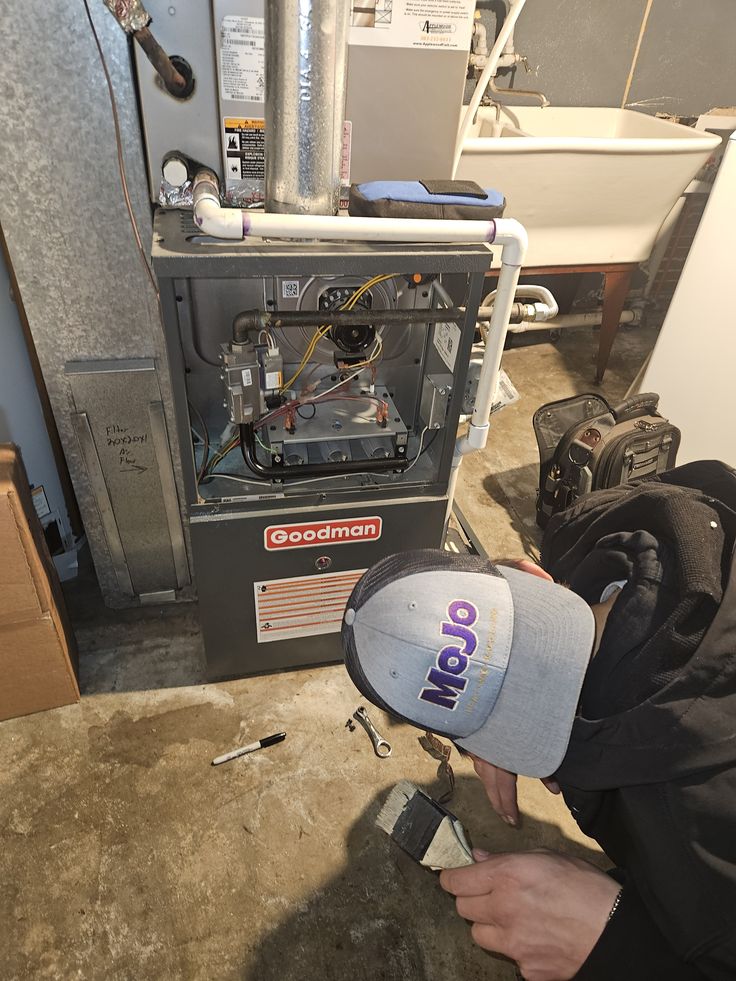
Because the control board cannot prove the flame it just made. A flame sensor is not a temperature switch - it is one leg of a rectification circuit. The board puts AC voltage on a steel rod sitting in the flame; ionised combustion gas conducts in one direction only, toward the grounded burner, and the board reads the resulting DC current in microamps. When that current falls below the manufacturer's threshold the board closes the gas valve within a couple of seconds and retries. Three failed trials and it locks out. The sequence a homeowner describes - ignites, burns briefly, quits, repeats, then goes quiet for an hour - is almost never the igniter.
What flame signal should a furnace produce at 5,768 feet?
Most residential boards want between 1 and 6 microamps DC read in series with the sensor lead, and drop out below roughly 0.5 to 1.0 depending on the manufacturer. A meter is the only honest test, because the oxide film that kills rectification is frequently invisible. Three things pull the signal down here: build-up on the rod, a degraded ground path - rectified current returns through chassis ground, so a corroded burner-assembly screw can halve the reading - and a flame that no longer fully engulfs the rod. The last one is specific to altitude. A furnace correctly set up for 5,768 feet fires through smaller orifices or at reduced manifold pressure, and a lower fuel rate makes a physically smaller flame envelope, so a rod positioned for sea-level flame geometry can end up at its edge rather than inside it.
What does the 15.1% derate do to burner run time in Dakota Ridge?
Take a 100,000 BTU/hr furnace: at Dakota Ridge's elevation it puts out roughly 84,900 BTU/hr, so 15,100 BTU/hr is gone before a single duct leak. An 80,000 BTU unit lands near 67,900. The house still loses the same heat, so the burner runs proportionally longer to replace it - about 18% more burner minutes per unit of heat delivered than at sea level. That is 18% more time with the sensor rod immersed in flame every season, accumulating the film that ends in a lockout. It is also why flame-signal calls in Dakota Ridge cluster in January rather than October: the deposit reaches the drop-out threshold after the heaviest run weeks, not before them.
Does cleaning the flame sensor actually fix it?
Sometimes, and it is the right first move - but it is a maintenance action, not a diagnosis. Fine abrasive removes the film and the reading usually snaps back. What matters is what the signal does afterward. Back to 4 or 5 microamps and holding steady through a full cycle means the rod was simply dirty. Back to 1.2 and sagging as the burner heats means something else is at work: a marginal ground, a cracked porcelain insulator bleeding current to the burner bracket, a chafed sensor lead, or a drifted sensing circuit. We write down the reading before and after so the next visit starts from a number instead of a story.
What else gets measured on a Dakota Ridge no-heat call?
The whole sequence of operation, in order, because a flame-proving symptom can belong to something upstream. Thermostat call and 24-volt supply. Inducer start and pressure switch closure, with the switch's actual negative pressure read against its stamped set point. Igniter resistance cold and current draw hot. Manifold pressure under fire, checked against the altitude setup on the rating plate. Flame signal in microamps. Temperature rise across the heat exchanger against the printed range. Limit and rollout continuity. The manifold reading is the step most often skipped, and at 5,768 feet it hides an under-fired or over-fired furnace that keeps producing symptoms after the sensor is clean.
Which Dakota Ridge furnaces are still worth repairing?
Flame sensors, igniters, pressure switches and inducer motors are contained repairs, worth doing on almost any furnace with a sound heat exchanger behind them. A community of 33,892 carries a wide spread of build eras, and age by itself rarely settles the question. Replacement becomes the better use of the money at a cracked exchanger, a failed integrated control whose parts are no longer stocked, or three separate subsystems failing in one season.
Who permits furnace work in Dakota Ridge?
Jefferson County is the building authority for Dakota Ridge addresses, the same jurisdiction covering Morrison at 5,764 feet - four feet lower, an identical 15.1% - and Ken Caryl at 5,761 feet and 15.0%. Component repairs do not need a permit; a furnace change-out does, and MoJo files it and books the inspection. Drop 417 feet to Littleton at 5,351 feet and the derate falls to 13.4% - 1.7 points, about 1,700 BTU/hr on a 100,000 BTU furnace, and the reason a heat-loss calculation does not travel between the two addresses.
Nearby towns we cover
The crews that cover Dakota Ridge also run furnace repair in Ken Caryl, furnace repair in Morrison, furnace repair in Littleton.
The opposite season has its own failure list: AC repair in Dakota Ridge.
Background on the service is at furnace repair; the full local list is at everything in Dakota Ridge.

Dakota Ridge
Home Of The $39 Diagnosis
Book your diagnostic today!
The $39 diagnostic service is a professional troubleshooting visit performed by a certified MoJo technician to identify the root cause of an HVAC issue.
Frequently Asked Questions
Why does my Dakota Ridge furnace light and then shut down after a few seconds?
The board is not seeing enough flame current. A flame sensor rectifies a small DC signal through the flame, typically 1 to 6 microamps, and when oxide film, a poor ground or a shrunken flame envelope drops it under the drop-out point, the gas valve closes within seconds. After three tries the furnace locks out. At Dakota Ridge's 5,768 feet the film builds faster because burners run longer.
How much heat does a furnace actually deliver at Dakota Ridge's elevation?
About 84.9% of its rated input. Dakota Ridge sits at 5,768 feet, and the standard 4% per 1,000 feet above 2,000 feet gives a 15.1% derate. A 100,000 BTU/hr furnace delivers roughly 84,900 BTU/hr and an 80,000 BTU unit about 67,900. The burner then runs around 18% longer per unit of heat delivered than it would at sea level.
How is a flame sensor tested rather than guessed at?
With a multimeter in series on the sensor lead, reading DC microamps while the burner fires. Visual inspection is unreliable, because the oxide film that blocks rectification is often invisible. We record the reading before cleaning and after, then watch whether it holds through a full cycle. A signal that cleans up and then sags again in a Dakota Ridge furnace points at the ground path or the sensor lead, not the rod.
Is Dakota Ridge's furnace derate different from Morrison's?
No. Morrison sits at 5,764 feet against Dakota Ridge's 5,768, a four-foot gap that rounds to the same 15.1% derate, and both are permitted through Jefferson County. The comparison that does change the answer is Littleton at 5,351 feet, 417 feet lower at 13.4%, which is about 1,700 BTU/hr of delivered heat on a 100,000 BTU furnace.
Does a furnace repair in Dakota Ridge need a Jefferson County permit?
No. Replacing a flame sensor, igniter, pressure switch, limit switch, inducer or gas valve at a Dakota Ridge address is unpermitted repair work. Replacing the furnace itself is permitted through Jefferson County, and the permit takes in the venting and gas connection as well as the appliance. MoJo Home Services is licensed and insured and files replacement permits as part of the job.
MoJo Home Services
A note for our neighbors
What we are proudest of in Dakota Ridge is being asked back. The same households ring us the next time something goes wrong, and then they give our number to the neighbor up the hill. That is how a small heating repair company like ours survives, and we are grateful for all of it.

Furnace Repair
In
Dakota Ridge
Share Your Experience
Thank you for supporting our local family business. If we did right by you, we'd love to hear about it on any site you use.
- Write a Google reviewQuick & easy
- Find us on YelpRead what neighbors said
- Review us on FacebookShare with friends
- Recommend us on NextdoorTell your neighbors


Your referrals and reviews not only mean so much to us, they also help the community know who to trust to Get their Home's MoJo Back!
Honest feedback is what we're after, good or bad. If something fell short, call us at the office first and we'll make it right.