Welcome, Neighbors of
Denver
AC Repair in Denver, CO
Denver homes run the whole range, from brick bungalows that had cooling added long after they were built to newer infill going up on the same block. That mix is why no two no cool calls here look alike. Family owned since 2009, licensed and insured, and based right here in the city.
5-star rated · Local & Family-owned since 2009
Licensed & Insured
Family Owned
NATE Certified
EPA Certified
BBB Accredited
Serving Denver Metro

See your neighbor deals
MoJo Home Services
Out in your neighborhood · Denver Metro
Air Conditioning Repair in Denver
A Denver air conditioner does almost no dehumidifying. At 5,279 feet in a semi-arid climate, summer wet-bulb temperatures sit low enough that the cooling load is nearly all sensible heat, which means a Denver system producing no condensate at the drain pan is usually healthy. The things that actually fail here are capacitors, coils, airflow and charge. MoJo Home Services has diagnosed them in Denver homes since 2009 — licensed, insured, EPA-certified, 720-807-4050.
Why doesn't my Denver AC produce any water at the condensate drain?
Because there is very little moisture in the air to condense. In a Gulf Coast climate, 25–30% of an air conditioner's rated capacity goes into pulling water out of the air. In Denver the sensible heat ratio on a typical July afternoon runs close to 1.0, so the evaporator often runs completely dry and the drain stays empty for weeks. That is normal at 5,279 feet. The reverse is what concerns us: a Denver coil streaming condensate on a hot dry afternoon is usually a coil starved of air, running well below dew point because the blower or the duct system cannot keep up.
What temperature split should a Denver air conditioner deliver?
Higher than the number on most reference charts. The familiar 16–20°F supply-to-return split assumes a share of capacity is being spent on latent load. Strip that out, as Denver's dry air does, and a healthy system commonly reads 20–25°F. That cuts both ways: a Denver homeowner who measures 19°F and calls it fine may be looking at a meaningfully undercharged system, because 19°F is mediocre in this climate. Add the 14.6% air density deficit at 5,279 feet and the mass flow behind that split is lower than the thermometer suggests. Split alone is not a diagnosis here.
Should I keep repairing my evaporative cooler or switch to refrigerated air?
Denver is one of the few places in the country where that question is genuinely open. Evaporative coolers work off wet-bulb depression and Denver has plenty of it, but they need windows cracked, they add moisture indoors, and they fade during the humid stretch in late summer. The conversion catch is ductwork: an evaporative system is sized for very high air volume at a small temperature drop, while refrigerated cooling at 5,279 feet needs roughly 468 actual CFM per ton against real static pressure. Reusing evaporative duct without measuring static is the most common reason a converted Denver home cools unevenly afterward.
What makes AC repair different in Denver's older housing?
Denver is the largest city we serve at roughly 729,000 people, and it carries the widest spread of construction eras in the metro. That shows up as cooling retrofitted onto systems never designed for it: undersized returns, long line sets, and condensers wedged into narrow side yards. Manufacturers specify clearance for a reason. An outdoor unit boxed in by fence and wall re-ingests its own discharge air, condensing temperature climbs, head pressure follows, and the compressor draws more current for less cooling. On a tight Denver lot, relocating a condenser eighteen inches sometimes accomplishes more than any part we could sell you.
What fails most on Denver air conditioners?
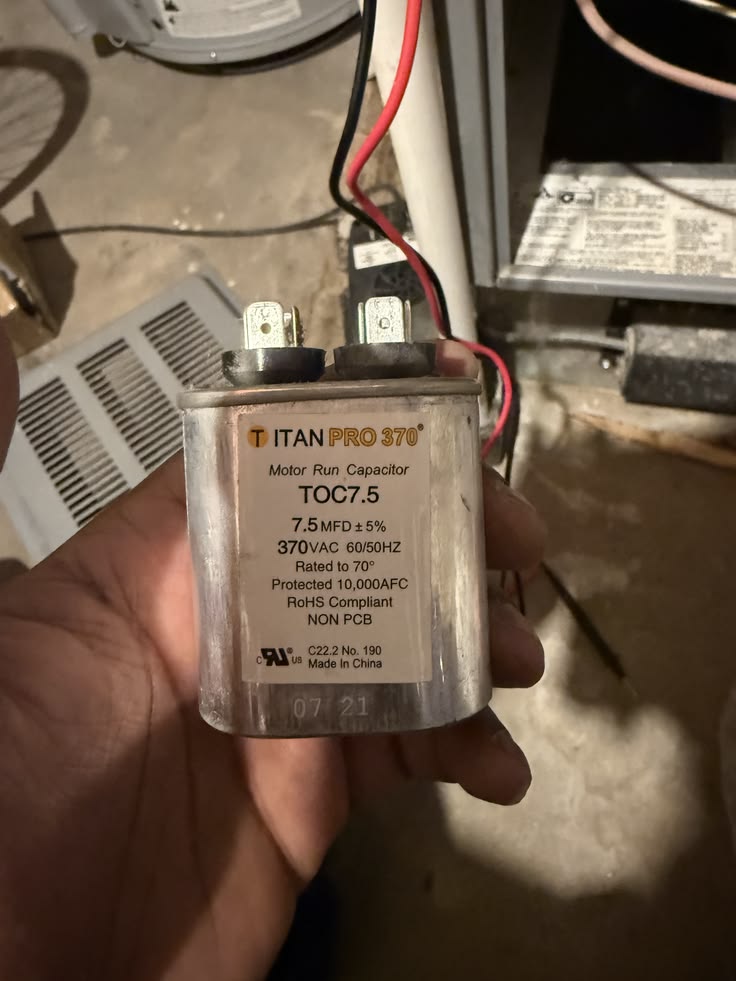
Run capacitors lead the list. They are electrolytic parts rated in microfarads, they drift downward with heat and age, and we replace them when measured capacitance falls more than 6% below nameplate. After that come contactors with pitted or welded contacts, condenser fan motors, slow leaks at service valves and brazed joints, and blower wheels loaded with dust. Refrigerant type sets the repair-versus-replace line: R-22 systems, generally anything installed before about 2010, have had no new U.S. production or import since 2020, and new equipment moved to R-454B under the AIM Act phasedown in 2025.
Who issues the permit for AC work in Denver?
Denver is a consolidated city and county, so there is one authority rather than the city-plus-county split most of our service area deals with. As a rule, a like-for-like repair does not require a permit. Replacing a condenser or evaporator coil, or altering the disconnect or the circuit feeding it, generally does. We pull what the job requires and handle the inspection, and refrigerant work is performed under EPA Section 608 certification either way.
Where else we work around Denver
Glendale and Edgewater are separate municipalities entirely surrounded by Denver, so a house a few blocks from one of our Denver calls can sit under a different building department. Park Hill is Denver proper. All three sit within a few dozen feet of Denver's 5,279, so the altitude arithmetic above carries across unchanged.
Nearby towns we cover
The crews that cover Denver also run AC repair in Park Hill, AC repair in Glendale, AC repair in Edgewater, AC repair in Longmont, AC repair in Bow Mar, AC repair in Eldorado Springs, AC repair in Floyd Hill, AC repair in Green Valley Ranch, AC repair in Northwood Acres.
The opposite season has its own failure list: furnace repair in Denver.
Background on the service is at AC repair; the full local list is at everything in Denver.

Denver
Home Of The $39 Diagnosis
Book your diagnostic today!
The $39 diagnostic service is a professional troubleshooting visit performed by a certified MoJo technician to identify the root cause of an HVAC issue.
Frequently Asked Questions
Why is there no water in my Denver AC's condensate pan?
Because Denver's air at 5,279 feet holds very little moisture to condense. The sensible heat ratio here runs near 1.0 on a summer afternoon, so the evaporator coil frequently runs dry and the drain stays empty for weeks at a time. That is expected. A dry pan in Denver is not evidence of a fault, and a wet one on a hot dry day is worth investigating.
What temperature split is normal for a Denver air conditioner?
Roughly 20–25°F between return and supply, not the 16–20°F printed on charts written for humid climates. Because Denver's cooling load is almost entirely sensible, more of the capacity shows up as temperature drop. A 19°F split that would be healthy in Houston can indicate an undercharged or airflow-restricted system at Denver's 5,279 feet, so we never diagnose on split alone.
Can I convert my Denver swamp cooler to central air conditioning?
Usually, but the ductwork decides how well it goes. Evaporative systems move very high air volume at a small temperature drop, while refrigerated cooling at Denver's 5,279 feet needs about 468 actual CFM per ton against real static pressure. We measure total external static before quoting, because reusing evaporative duct unmeasured is the leading cause of uneven cooling after a Denver conversion.
How much clearance does a condenser need on a narrow Denver lot?
Most manufacturers want unobstructed sides and roughly five feet of clear space overhead. Denver's older neighborhoods have tight side yards, and a condenser boxed in by fence and wall re-ingests its own hot discharge air, raising condensing temperature, head pressure and compressor current. On many Denver calls, correcting clearance recovers more capacity than replacing a part would.
Does Denver require a permit to replace an air conditioner?
Replacing a condenser or evaporator coil, or changing the disconnect or circuit, generally requires a permit, while like-for-like repairs generally do not. Denver is a consolidated city and county, so a single authority handles it rather than the two-layer arrangement in surrounding jurisdictions. We pull the permit and schedule the inspection, and all refrigerant work is done under EPA Section 608 certification.
MoJo Home Services
A note for our neighbors
Denver is big enough that most people never meet the neighbors two doors down, so when someone still passes our name along for an AC repair it carries real weight. We are a family business, and being trusted like that in a city this size is not something we take for granted.

On the job
In
Denver
Share Your Experience
Thank you for supporting our local family business. If we did right by you, we'd love to hear about it on any site you use.
- Write a Google reviewQuick & easy
- Find us on YelpRead what neighbors said
- Review us on FacebookShare with friends
- Recommend us on NextdoorTell your neighbors


Your referrals and reviews not only mean so much to us, they also help the community know who to trust to Get their Home's MoJo Back!
Honest feedback is what we're after, good or bad. If something fell short, call us at the office first and we'll make it right.